| Introduction to FEA CD $59.99 |
sign up for the
Introduction to FE Analysis
Tutorial CD
Introduction to FE Analysis
Tutorial CD
 |  |  |  |
FETraining

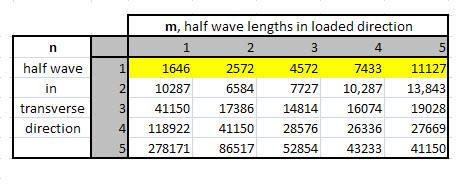
The equation is used in a spreadsheet to solve for critical buckling load for the example, varying
m and n. The table below shows the results.
The first result found for the analysis was the first (lowest) eigen value giving the first critical
buckling load of 1646 lbs.
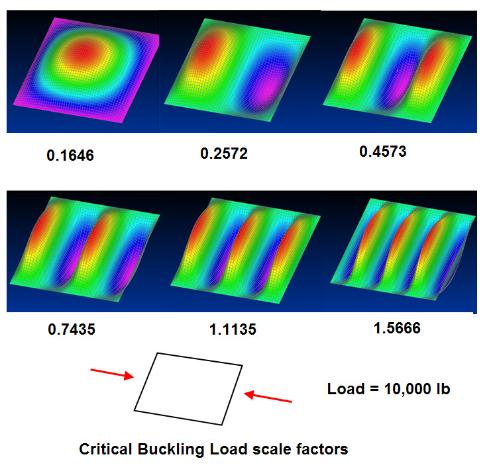
The first 20 eigen values were requested in this analysis. The figure below shows selected
results with their eigen values for n = 1.
The highlighted values in the table match the eigen values found. Note that the result for [6,1] is
shown in the figure, but the table only goes up to m = 5.
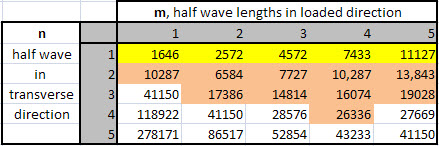
There are other families of modes found in the extraction. In fact all modes up to an eigen value
of 2.6294 were obtained. The table below shows the modes [m,n] that were included in the
extraction. The highest mode found at [4,4] is slightly inaccurate compared to the theoretical
value of 2.6336.
The order in which the modes is extracted is in increasing eigen value, or critical buckling load.
It is therefore [1,1], [2,1], [3,1], [2,1], [4,1], [3,2] etc.
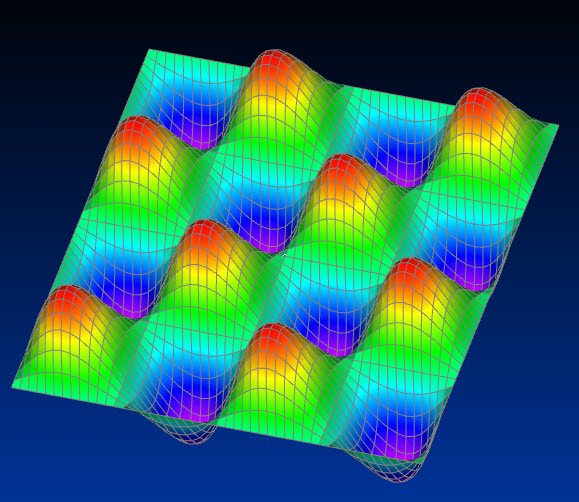
Mode [4,4], at 26336 lbs, is shown for interest.
The higher order modes may not be of practical use, but it is useful to understand that buckling
results in a family of modes. The first (lowest) mode may be the most important, but in some
structures such as cylindrical shells there can be many mode shapes vying for the lowest spot!
The accuracy and order of eigen values is very dependent on modeling issues such as
boundary condition and load application, and of course very sensitive to real world variations in
material, geometric accuracy and other imperfections. All this makes having a knowledge of
what is around the corner very useful.
The next page describes the very particular Nastran FE boundary conditions required to set up
this problem. They are not quite as trivial as they seem unfortunately!